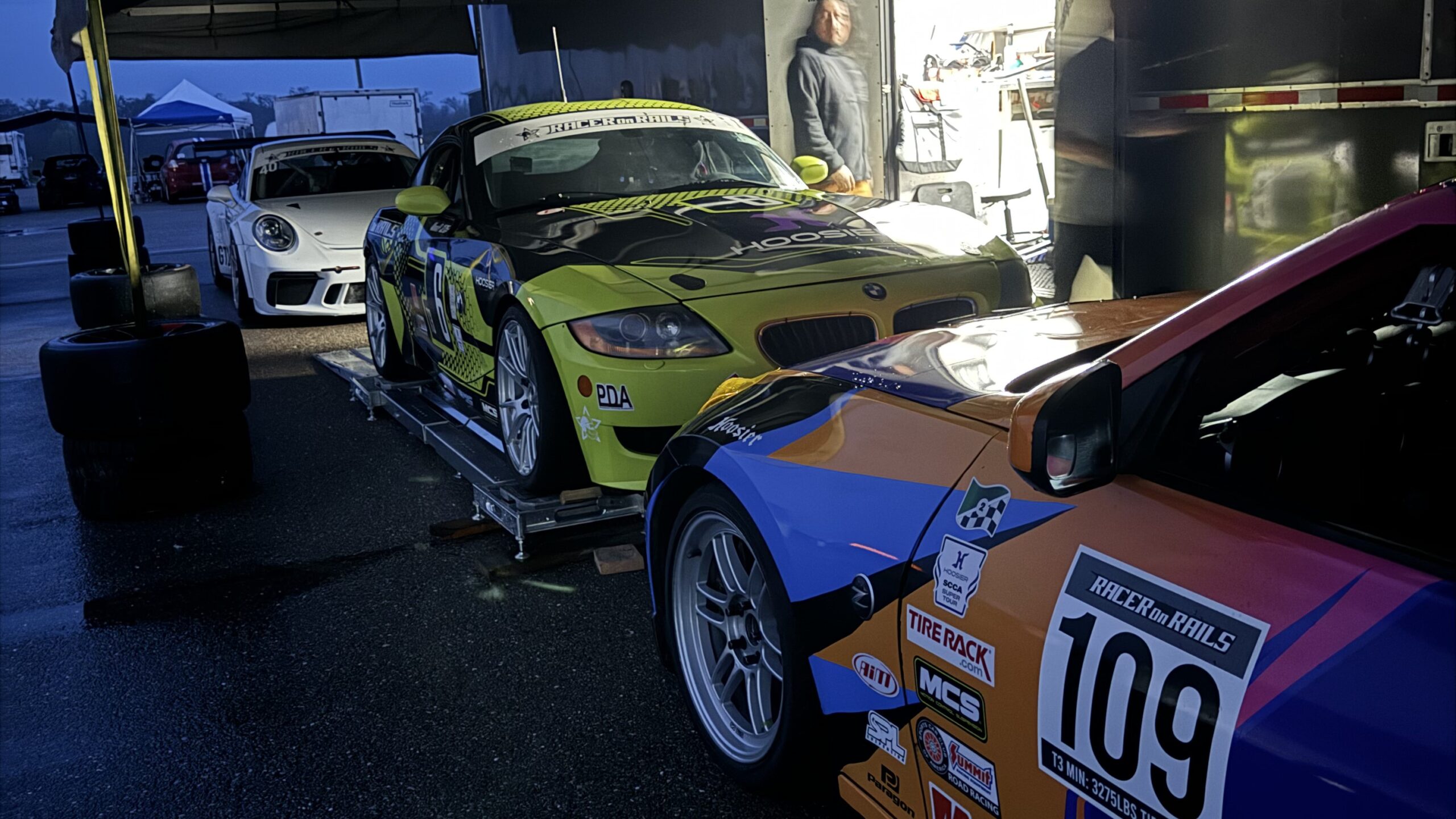
Every race car has a story, and our goal with these build overviews is to pull back the curtain a bit and share the why behind each one. Not just the spec list or the shiny parts bolted on, but the decisions that shaped the build, the lessons we learned the hard way, how the car performs today, and where we’re taking it next. Think of this as a guided walk through the full journey — the good, the bad, the breakthroughs — so that whether you’re dreaming up your first build, refining a current project, or planning something wild for the future, you’ve got real-world insight to draw from. And hey, if any of this sparks ideas or you’re curious about building a similar car, we’re always happy to talk shop and help you get pointed in the right direction.
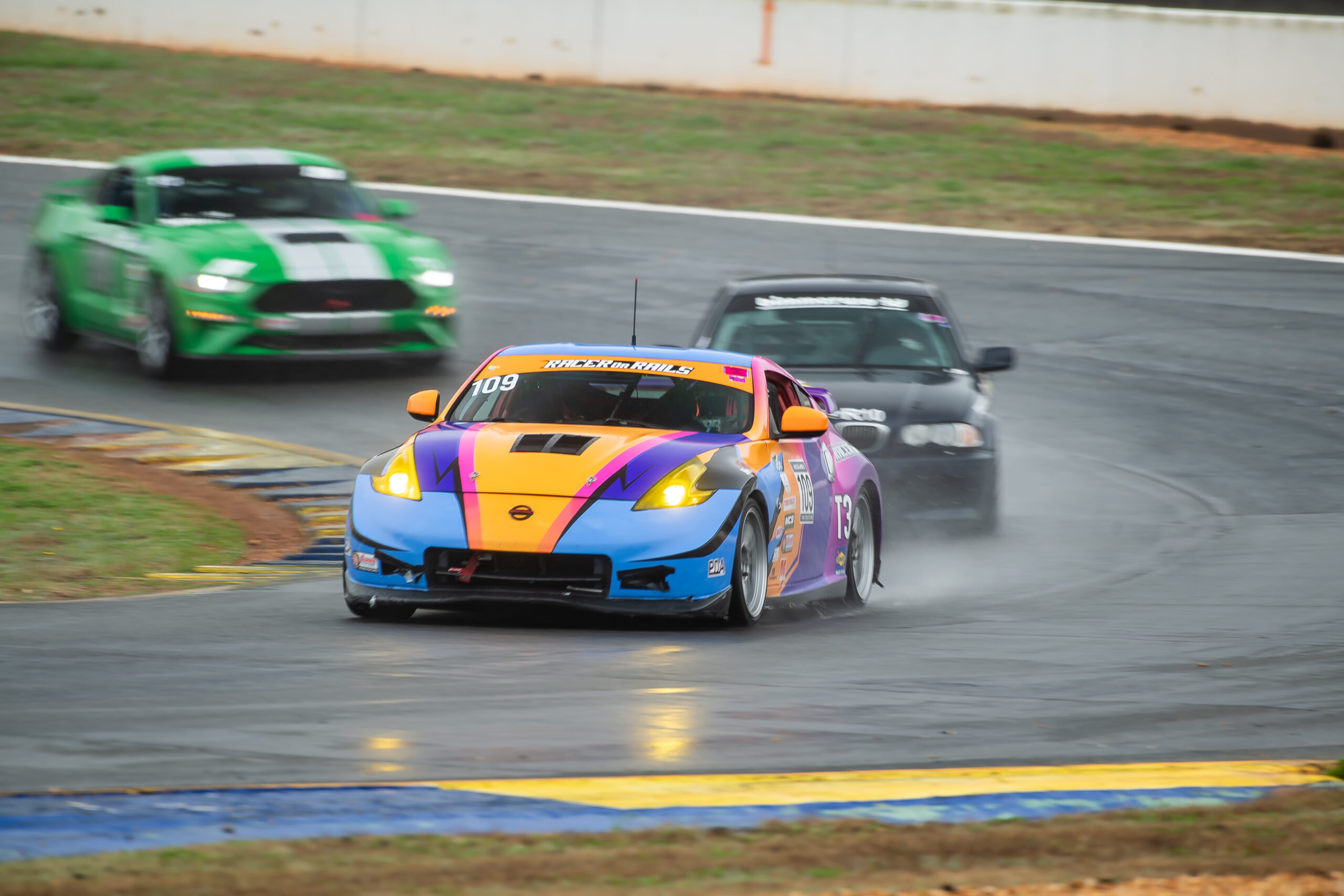
Gama shaking down and testing things to figure out the brakes in his 2011 Nissan Nismo 370Z in SCCA Touring 3 Class
How We Ended Up in a Nissan 370Z for Touring 3
Our path to campaigning a Nismo Nissan 370Z in SCCA Touring 3 didn’t start with a Z-car at all — it started with a fleet of BMW Spec E46s and a once-in-a-lifetime opportunity.
Back in 2021, the SCCA Runoffs were being held at the Indianapolis Motor Speedway. That’s bucket-list territory. There was absolutely no way we were going to miss the chance to race at Indy, so we brought our Spec E46 drivers and cars and dove into T3 with both feet.
That first year was awesome. The SE46 was decently competitive and, with a 2,950-lb minimum weight in Touring 3 (vs. 2,850 in the spec class), we still felt like the platform had room to grow. We were optimistic.
Even a hurricane couldn’t slow down the field enough to make a Spec E46 competitive at big tracks like VIR
But 2022 at VIR changed everything.
VIR is the polar opposite of Indy when what matters most is top-end speed. And in T3, you simply cannot hide from that reality. While the front-running cars were consistently touching 138–140 mph top speeds, our Spec E46s were essentially tapped at 136 mph, and in reality at VIR, we were barely seeing 132 mph with a draft.
So even if the chassis could somehow theoretically match the lap times, the racing wasn’t viable. It was a harsh reality check, but a necessary one.
Time for a Change
After the 2022 Runoffs, we evaluated realistic alternatives:
BMW Z4 M Coupe
Nissan 370Z
We also had a 2010 Porsche Cayman PDK ready to build, but the timeline and development curve didn’t match our Runoffs schedule.
The turning point came when a proven, nationally competitive T3 370Z changed hands and landed with our friend Chris Hart. Suddenly, we had access to race-winning data and real experience. Combined with the 370Z’s double-wishbone geometry — perfect under T3’s 3.5-degree camber limit — the choice became clear.
Buying the Car — A True Nismo
In mid-2023, we bought a 2011 Nissan 370Z Nismo — a true, original-owner Nismo.
Because the shop was at max capacity, the entire initial teardown happened in the driveway. Full interior strip, seam sealer removal, weight reduction — everything. We delivered a perfect rolling chassis to Fabtek for a cage that matched Chris’s championship-proven design.
Cage & Safety Fabrication
Once Fabtek completed the cage, we resprayed the interior in OEM Nismo red and began the race against time to assemble the car before the 2023 Runoffs at VIR.
Prepping the interior for the cageTrailering the car to get a cageAssembled just in time for the runoffsFront angle view, just in time for the Runoffs
2023 Runoffs — The ABS Reality Check
We made it to VIR… but the first test day exposed the 370Z’s biggest flaw: its factory ABS logic.
We experienced full-on ICE mode, where the ABS system dramatically reduces braking pressure unpredictably. It ended our Runoffs before the weekend truly began — but thank God, the car and driver were safe.
Post-Runoffs: Fixing the Brakes
That failure changed everything. We went deep into:
pad compounds
rotor configurations
wheel-speed ratios
heat management
master cylinder behavior
ABS trigger logic
We broke things. Tested everything. Logged everything. Even pushed for rule adjustments when needed.
And now? The brakes are one of the absolute strengths of the car.
Current State of the Car
Chassis
2011 Nissan 370Z Nismo
SCCA-compliant Fabtek cage
OEM interior respray (red)
OEM front strut bar
No additional chassis stiffening (per T3 rules)
Interior & Safety
Racetech 119 seat
Schroth 6-point
Safecraft nets
Lifeline fire system
OMP wheel
Helmet blower + cool shirt
Lots of heat shielding at the transmission tunnel to protect driver’s feet
Rear trunk area clean and organizedCenter console area retained for OEM built race car lookAll business from the driver seat
Brakes
Paragon PA015 calipers
Paragon 2-piece rotors
Carbotech XP12 front pads / 1521 rear pads
Motul RBF660
Goodridge stainless lines
Racer on Rails custom brake ducts
Fully optimized ABS strategy
Suspension
MCS 3-way coilovers
Eibach T3-compliant springs
SPL adjustable arms & endlinks
AFE sway bars
Urethane diff mount
Engine
Nissan reman VQ37HR
Z1 baffled oil pan
OEM intakes (required)
42mm restrictor
Motordyne test pipes
Z1 single-exit exhaust
ECUTek tuned on 100 octane
Comprehensive cooling upgrades
It’s a Z battle at the 2025 SCCA Runoffs!
Aero
OEM Nismo V1/V2 aero
Race Louvers center hood louver
OEM body panel constraint for T3
Electronics
AIM MXS v2 + SmartyCam 3 dual
Switch-Pro control system
Full auxiliary sensor package
Motorola long-track radio
Drivetrain
CAE shifter (350Z variant custom-adapted)
Tomei 1.5-way LSD
OEM mounts (urethane where allowed)
Diff & trans coolers
Enkei RFP1 18×10.5 + Hoosier A7s
Racing & Driving Highlights
???? 2024 Hoosier Super Tour Win — NOLA Motorsports Park
The car’s first national-level win (but technically a P2 due to post-race adjustment). New track, technical course, colder weather and still figuring out the brakes.
Video:
???? 2025 CAT Majors Win — Road America
90°F, extreme humidity, and the car delivered a dominant run once we were in clear air.
Video:
???? Global Time Attack — The Ridge Motorsports Park
Unrestricted laps on Yokohama A052s showed the Z’s true potential.
Video:
What We’ve Learned
The car loves mechanical grip.
Weight distribution & stiffness tuning are critical.
The ABS and braking system is both the biggest weakness and the biggest opportunity.
Heat management is everything in longer races/sessions and when air temps get above 80F.
The Z rewards smooth inputs and stability.
Parts availability is excellent with the right partners.
Future Direction — Where #109 Is Headed
More engine & cooling refinement
Testing Paragon PA015 big-brake upgrade
Further alignment/tire data development
Weight management improvements
Full prep for 2026 Hoosier Super Tour + Runoffs
Thinking About Building a Production-Based Race or Track Car?
If this build sparks any questions, ideas, or “should I do this with my car?” thoughts, reach out. Whether you’re dreaming up a production-based track car, considering something in the SCCA Touring 3 or Touring 2 world, or want to explore a power-to-weight package similar to this build, we’re always happy to help you think through the right path.
From full builds to setup refinement, from brake and cooling solutions to driver development, we love partnering with drivers to create fast, reliable, confidence-inspiring cars. If something here resonated with you — let’s talk.
The 2026 season is officially underway, and our calendar is set. If you’ve been thinking about getting on track, racing more seriously, or stepping into a new program, then right now is the moment to get aligned. Once the season starts stacking, and things are heating up now, prep windows tighten quickly — especially for multi‑event campaigns.
With that in mind, here’s where Racer on Rails will be throughout the 2026 racing season. If any of these events are on your radar, reach out ASAP so we can map out your prep with intention.
SCCA West Coast — Majors, Super Tour & Runoffs
Feb 20–22 – Buttonwillow
March 27-29 Thunderhill SCCA Regional
May 8–10 – Portland SCCA Hoosier Super Tour (Mother’s Day Weekend)
May 23–24 – Pacific Raceways SCCA US Majors (Memorial Day Weekend)
Sept 25-27 & Oct 2–Oct 4 – Road America SCCA Runoffs
If you’re aiming for a Runoffs qualification campaign or national level competition, this is the ladder.
ICSCC Conference — Pacific Northwest Core Program
April 24–26 – Portland
May 15–17 – Pacific
June 19–21 – Portland
June 26–28 – Pacific
July 31–Aug 2 – QRP
Aug 14–16 – The Ridge
Sept 18–20 – Portland
Oct 9–11 – Portland (8‑Hour)
For Northwest‑based drivers looking to build racecraft, consistency, and confidence in a tight‑knit paddock, this is home base.
NASA — HPDE, Time Trial & Racing Ladder
Mar 6–8 – Sonoma
June 5–7 – ORP
July 17–19 – ORP
Aug 14–16 – Portland
Sept 4–6 – Pacific
Oct 23–25 – The Ridge
NASA offers one of the clearest progression paths from HPDE to Time Trial to wheel‑to‑wheel racing.
PCA Club Racing
Jan 30–Feb 1 – Sebring
April 10 – 12 – Road Atlanta
July 10–12 – Watkins Glen
Sept 4–6 – Road America
If you’re running a Porsche platform and want structured, national‑level competition, this is a strong calendar.
OnGrid Time Attack — Full PNW Calendar
We will be supporting the full OnGrid PNW calendar in 2026.
March 27-29 – The Ridge
May 22-24 – The Ridge
May 29-31 – Thunderhill (GTA)
June 19-21 – Pacific
July 24-26 – The Ridge
If you’re building a time attack car, refining aero, or sharpening qualifying pace, we’ll be there.
GLTC — Laguna Seca
We will be attending GLTC at Laguna Seca in 2026 as part of our Time Attack and related driving programs.
April 17-19 – Carolina Motorsports Park
May 8-10 – Road Atlanta
June 12-14 – Gingerman Raceway
July 24-26 – Watkins Glen
Aug 21-23 – Lime Rock Park
Sept 18-20 – Laguna Seca – committed to this event only for 2026
If national exposure, high‑energy sprint racing, and a dynamic paddock appeal to you, this is an event to plan early for.
Track Days & Competition License Schools — ProFormance Racing School
For drivers earlier in the journey — or those ready to earn a competition license — we will continue supporting participation in track days and competition school programs with ProFormance Racing School.
We can help align your goals, prepare your car, and integrate your track day progression into a broader racing plan.
Track days aren’t separate from racing — they’re often the first step toward it.
What This Means for Your 2026 Season
If you:
Want to run even one of these events
Need race prep, dyno, setup, or Test Ready certification
Want coaching support
Are exploring a full‑season campaign
Are starting with track days or license school
Our shop capacity, coaching calendar, and trackside support structure are built around this schedule. Aligning early ensures we can support your goals with the time and attention they deserve.
Welcome Keri and Ian Anderson to the Racer on Rails Team!
We’re excited to officially welcome Keri and Ian Anderson to the Racer on Rails crew!
If you’ve been around us at the track the last few seasons, you’ve probably already seen them in action — whether it’s wrenching in the paddock, reviewing data late into the night, or debating the finer points of shock tuning, telemetry, tire graining, and simulator setups. We’ve worked alongside Keri and Ian for years as part of our race weekend crew, and before that, we knew each other as friendly competitors and fellow motorsport nerds for over a decade.
Keri joins the team as Service Advisor, Race Car Engineer, and Project Manager, bringing her sharp technical insight and deep experience managing complex race programs from start to finish.
Ian joins as Race Car Technician, Fabricator, and Dyno Operator, where his hands-on expertise, mechanical creativity, and dedication to precision will help keep our cars fast, reliable, and ready to perform.
Together, they bring even more power to our mission: helping drivers reach their goals, create lasting memories, and leave every weekend with a huge smile.
If you’re curious about what it’s like to work with the Racer on Rails team — whether you’re prepping for your first track day, chasing a national championship, or just looking to take your driving to the next level — reach out and connect with us. We’d love to talk about how we can help you go faster, safer, and smarter.
A few weeks ago, we were at Road America for one of the most iconic events in club racing: the SCCA June Sprints.
There are tracks—and then there’s Road America. Nestled in the rolling hills of Elkhart Lake, Wisconsin, Road America is one of the most iconic and demanding circuits in North America. At 4.048 miles, it’s one of the longest permanent road courses in the country, with 14 turns that blend technical precision with full-send bravery. Corners like the Kink, the Carousel, and Canada Corner don’t just test your car—they test your commitment. Turn 5 is the “slowest” min-speed corner at a target min-speed of 55-60 mph, depending on the car! That is the “slowest” with the rest of the corners having target min-speed of 65, 80, 90 and 110 mph. ????
And then there’s the June Sprints—a race weekend steeped in history. Since 1956, the June Sprints have stood as a cornerstone of American amateur road racing. It’s a proving ground for national champions and future pros, where every lap carries the weight of decades of racing tradition.
But what truly sets this weekend apart is Elkhart Lake itself. This little town breathes motorsport. Historic restaurants like Siebkens and The Osthoff are filled with old racing photos and stories, and the street signs and commemorative plaques around town proudly mark the original road course from the 1950s, when racing took place on public roads. It’s a place where history isn’t just remembered—it’s woven into the landscape.
Just down the road is RealTime Racing HQ, a name familiar to any longtime fan of World Challenge or Honda racing, SO COOL! And everywhere you look during June Sprints weekend, the town is buzzing with performance cars—from vintage Porsches to modern GT4 machines. It’s a car lover’s paradise, and for racers like us, it’s nothing short of heaven.
Big Brains, Big Gains – Engineering First
Before a single lap was turned, Tyler Campbell was already deep in the work: suspension geometry, brake data, tire modeling—he put in the kind of effort that sets great teams apart. We showed up with one of the most dialed-in testing plans we’ve ever run, and it paid off.
We don’t show up to look cool (or at least we think we try to look cool but look like a bunch of racing and track nerds! ????) and bench race. We’re here to science the crap out of our race cars and racing!
Gama and Tyler discussing setup options, data collected and how to move forward at June Sprints.
Wednesday & Thursday – Building the Foundation
We rolled in Tuesday night with storms on the radar. Wednesday morning was still wet, but once the track dried, we got to work. We missed the first test session due to the wet track and expected dry conditions through the rest of the race week, but kicked off our structured setup plan with back-to-back sessions focused on testing our hypotheses.
I ran our Spec E46, not because we expected to win overall, but because it gave us a solid, familiar platform to test against elite-level competition (and the Touring 3 Nissan 370Z needed another heart transplant, we’ll get into that more in a future post).
Every change delivered something new—every lap taught us something valuable.
Dave blasting through Turn 7, building speed and confidence lap after lap.
Thursday, we mounted fresh tires and saw a measurable step forward. All signs pointed toward progress, and it gave us confidence heading into the official sessions.
Friday – Contact, Recovery, and Grit
Morning practice started off well… until it didn’t.
Dave Orem got dive-bombed in Turn 1. The hit spun him, left him stalled, and another car—unable to avoid him—collected the Z4M hard.
Bryce and Rene hammer away at fixing a nearly fully destroyed front passenger side corner. Within 12 hours of total work time, across a couple days and with overnight delivery of parts, Dave and his Z4M Coupe were online and ready for qualifying session 2 and the race weekend!
Thankfully, Dave was okay. And thanks to an incredible community, we pulled off a minor miracle: sourcing every part needed to get him back on track.
Shoutout to Trevor and Wyatt at Motion Control Suspension for building a replacement MCS shock on short notice and getting it to us overnight.
Friday Qualifying – Almost There
Meanwhile, I was out for qualifying in the E46. Brand new tires. Low Super Tour points meant I was gridded at the back of the T3 field. But we knew we had pace.
Twice, I was on flying laps that would’ve moved me to P2 or P3—both times caught in traffic at the carousel and kink. Absolutely destroyed those laps.
We finished the day P4. Not ideal, but we knew more was coming.
Saturday – Reset & Rebound
With Dave’s car repaired, he jumped back in for qualifying.
“I didn’t think about the car at all. I was able to focus on finding space and putting down lap times.”
Exactly what you want to hear after an incident. He wasn’t fully back to pace yet but showed strong progress.
Dave building confidence in qualifying after the hit that took him out of Q1.
For me, Saturday qualifying locked in P4. Solid lap. Solid position. Not a perfect lap, but enough to put us in contention for Sunday.
Sunday – Race Day
Dave’s Race
Sunday morning, Dave started deep in mixed-class traffic. Lost a few spots at the start, but once the field spread out, he got to work.
Lap by lap, he found rhythm, overtook competitors, and with just a few laps to go—reset his personal best lap time.
He finished P5 in Touring 3, proud of the recovery but wishing he had the two missed sessions to build more momentum.
Dave making moves through the Sunday main Touring 3 race at the SCCA Chicago Region June Sprints. BMW Z4M Coupe T3 race car.
Gama’s Race
Hot, humid, and with storms on the radar. The goal? Finish to qualify for the Runoffs—and go for a podium if the opportunity was there.
Gama looking for a way through at the start of the Touring 3 SCCA Chicago Region June Sprints race.
Great start, dicing for P2 and P3 early. Lap 2 brought a jam up into Turn 3 behind a slowing T2 car. Another T3 car got through; I had to wait. That 3–4 second gap to P3 took several laps to close.
Then it happened.
P3 (another Spec E46) dropped a tire into the dirt under braking. Big wiggle. Lost momentum. I got in the draft, faked right, popped left, held side draft as we bent left—and completed the pass into Turn 5 with a wheel in or nibbling at the grass.
Gama looking to grow the gap to P4 during the SCCA Chicago Region June Sprints race at Road America in the Racer on Rails Spec E46 rental race car, the Silver Bullet!
From there? Hit marks. Build gap. Don’t look back.
By the final laps, the lead over P4 was 30+ seconds. P2 and P1 had gotten through the local yellow before me, and that ultimately determined the gap. I brought it home in P3.
One of the things I love most about racing is how often we’re proven wrong—and how that’s a good thing. What we “know” is always based on the best data and insight we’ve gathered up to that point. The goal isn’t to be right all the time—it’s to stay curious, stay humble, and keep growing.
And that’s what we did at Road America.
Let’s Build Your Path in Motorsports
If the way we race—the way we prepare, develop, and pursue excellence—resonates with you, let’s talk.
We’re not just about cars. We’re about people, progress, and purpose. And we’d love to help you chase your motorsport goals.
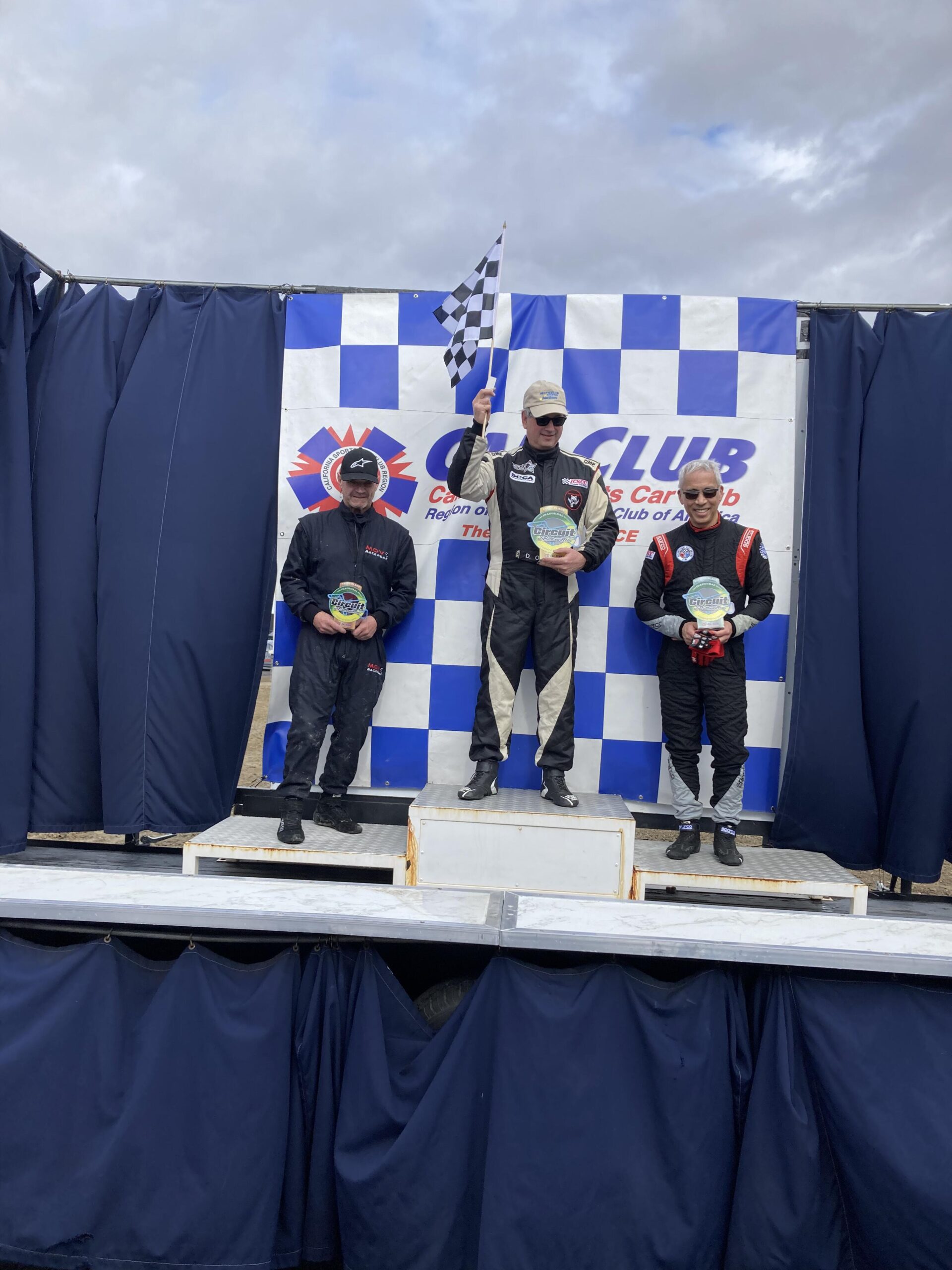
The 2025 Racer on Rails SCCA racing program kicked off in California at The Circuit, the newly built racecourse at Buttonwillow Raceway Park. This was a weekend of firsts—not just for us, but for the entire everyone, as we took part in the first-ever sanctioned race on the new track!
Everything about The Circuit was new; new track, new tire brand for both slick and wet setups, new coaching program, new competitors, and new adventures. Our drivers and crew had plenty to learn, and we approached the weekend with specific goals and a detailed game plan for each driver. With two days of testing, racing, and strategy calls, the team made incredible strides, achieving personal bests, podiums, and a 1-2 finish in Race 2 on Sunday.
Meet the team
Ron and Reid in impound, post-session
Ron Tanemura & Car Chief Reid Morris
#63 SE46 BMW 330i | SCCA Class – Touring 3 (T3)
2024 ICSCC SPM Class Champion ????
First-ever SCCA U.S. Majors Tour event
Entering Racer on Rails’ SCCA Competition Program
Ron has been racing with Racer on Rails in the Pacific Northwest for a few years, but this was his first-ever SCCA Majors Tour raceand his fist season working full time with Reid. After earning the 2024 ICSCC SPM Class Championship, he stepped up to challenge himself further in national competition. This weekend was a big new challenge —a brand-new track, new competitors, and a stomach bug. But Ron came ready to party, and nothing was stopping him.
Rene getting Dave strapped in for race 1.
David Orem & Car Chief Rene Perez
#6 BMW Z4 M Coupé | SCCA Class – Touring 3 (T3)
Touring 3 podium finisher
Has mastered Heel-Toe Shifting during the off-season
Goal-Oriented approach
Dave returns to our SCCA program looking toreach the sharp end of the T3 field. With a fresh rebuild on his Z4 M Coupé including a stunning new vinyl wrap, Dave arrives fit, focused and determined. The pairing showed steady progression all weekend, culminating in a checked bag fee on the flight home for a bag containing new hardware.
Simon’s sweet Porsche GT3 Cup Car in post race impound
Simon Asselin & Car Chief Jordan Allen (“The Doctor”)
#81 Porsche Motorsport 991.2 GT3 Cup | SCCA Class – GT2
2023 SCCA Touring 3 Points Champion
Racing in one of the most competitive SCCA grids, GT2
Third-fastest GT2 lap time of the weekend
Simon and Jordan have been working together for multiple seasons, and after a strong debut year in GT2 last season, they returned to challenge for the podium in 2025. This series offers the challenge of multi-class race groups including a large Spec Corvette field, Simon’s consistency and pace kept him at the front of the GT2 field, all while navigating the pack of slower class cars.
Friday Test Day – Cold Starts and First Impressions
We arrived at The Circuit before sunrise on Friday, greeted by well-below-freezing temperatures and frost covering everything—cars, buildings, and the track. Luckily, the team had already set up the night before, allowing us to jump straight into unloading and prepping for the 9:00–9:30 AM test session.
By the time the first cars hit the track, the frost had lifted, and the sun was breaking through. This was the first real-world drive for any of our drivers on the new layout, making it a crucial day of adaptation.
Driver Progress:
Simon Asselin: Locked in the 1:45 range, pushing near the expected top pace.
Dave Orem: Improved into the 2:06 range, showing steady progress.
Ron Tanemura: Battling fatigue, made strides before sitting out the final session to recover.
With simulator prep translating well to reality, we ended the day confident in the team’s progress heading into Saturday.
Saturday – Practice, Qualifying & Race 1
Saturday morning started with feedback sheets from Tyler Campbell, analyzing Friday’s data to pinpoint one or two focus areas for each driver. The goal: apply the learnings immediately in the morning practice and first qualifying session.
Ron had an early spin during morning practice, leading to the discovery of a failing battery. Missing part of practice, he rebounded well in qualifying. Dave executed perfectly, shaving seconds off his previous best lap.
Simon struggled with traffic in qualifying but still secures a start from row 2.
Saturday Qualifying Results:
Touring 3: Dave P2, Ron P5
GT2: Simon P3
Saturday Race 1 – Making History
T3 Race 1:
The first-ever sanctioned race on The Circuit was a split start, with Spec MX-5 Cup cars leading and Touring 3 cars behind. The race brings improving track conditions and with the help of lots of data and video analysis, defined goals and executing on our action plans, Dave charges to a 2nd place finish, while Ron continues to improve despite still recovering from food poisoning, finishing the race in 4th.
GT2 Race 1:
Better track conditions and cool air set the stage for Race 1 in GT2. Simon has some great racing of his own, as he trades positions with a few GT2 cars before finishing the race in 4th place.
Sunday – Morning Qualifying, Wet Track, Big Decisions
Early morning rain rolls in leaving us with a damp but drying track. Our turn is up for T3 qualifying and mixed conditions still exist. We are forced to make a strategy call on tires, so we go to Jordo at our Weather Desk. The decision is slicks, and it pays off as the track conditions improve and we begin finding speed in quali #2.
Sunday Qualifying Results:
Touring 3: Dave P2, Ron P3
GT2: Simon P3
Touring 3, Race 2 – The 1-2 punch!
The race begins with a 6-car battle into the first corner making for an exciting start. Dave sets the pace in class, while Ron, after fending off some light contact from another competitor, sticks to the the Z4M’s bumper and RoR takes a 1-2 finish in Race 2 for Touring 3. BOOM!
GT2 Race 2:
Simon has a solid start and runs in P3, involved in a 3-car battle for most of the race. After a restart from a full course caution, several cars experience wheelspin, resulting in a loss of 2 spots. Despite the setback, he fights his way back up, improving his personal best lap time by nearly three seconds (1:44.5) and finishes in P4.
Wondering what it’s like on the new circuit? Check out a fast lap in Simon’s Porsche 911 GT3 991.2 Cup Car
Final Thoughts – Goals, Smiles, Memories
As we packed up, we reflected on an incredible opening weekend. The new track, unpredictable conditions, and intense racing made for an unforgettable event.
Dave & Ron delivered a 1-2 finish in Touring 3.
Simon clocked the third-fastest GT2 lap of the weekend.
Breaking into high-performance driving can feel overwhelming, even with resources like driving schools and track days. For those new to this world, the challenges of cost, access, and preparation can seem daunting. Thankfully, there’s a way to build your driving skills and confidence right from the comfort of your home: simulators.
Why a simulator? Because you have to practice driving a car in a high performance manner and figure out and learn tracks.
If you’re just getting started, you’re not alone in feeling that even the simulator world can be complex. Gran Turismo 7 and Forza Motorsport have come a long way in recent generations, offering a balance of accessibility and realism. While they may not be as hardcore as iRacing or RFactor2, their physics engines have significantly improved from earlier arcade-style versions. The games now feature photo-realistic graphics, delivering some of the most visually stunning racing environments available in any form of media.
But in this guide, we’re focusing on the simplest and most accessible path: using a simulation-based game like Gran Turismo 7 on PlayStation 5 or Forza Motorsport on Xbox Series S or X, paired with a steering wheel and pedal set from makers such as Fanatec, Moza, Thurstmaster or Logitech. Why consoles? It’s the lowest cost and least complex way to get into sim driving.
In future posts, we’ll cover the more hardcore, usually more expensive, and more complex but more realistic world of PC simulators.
The Wheel and Pedal Set
While a controller technically works (and there are some seriously fast controller based sim drivers in the world), investing in a steering wheel and pedal set transforms the experience. Remember, you’re doing this because you want to drive in the real world, so you need to replicate the real world as best you can. You need to better replicate the sport driving seating and body position. Driving a car via a game controller won’t help you in driving a car with your hands, neck, feet, core, etc…
Here are some recommendations tailored to beginners using Gran Turismo 7 or Forza Motorsport:
Moza R3 Racing Wheel and Pedals: A fantastic entry-level option offering responsive feedback and solid build quality. It’s compatible with both PC and consoles, making it a versatile choice for beginners looking for immersive gameplay.
Logitech G29/G920: Affordable and compatible with both PlayStation (G29) and Xbox (G920), this set offers solid force feedback and durability.
Thrustmaster T248: A step up in features, it supports force feedback and customizable pedal resistance, making it great for beginners aiming for a more immersive experience.
Fanatec DD: For those wanting a premium experience, Fanatec offers wheel bases with direct drive technology, providing incredibly realistic feedback. Pair it with the Fanatec pedals and steering wheels for a plug and play experience.
Key features to look for include:
Force Feedback: Simulates the forces acting on the car for realistic feel via the steering wheel.
Responsive Pedals: Allows precise throttle and brake modulation.
Adjustable Settings: Customizable settings to match your preferences and skill level.
A basic setup can cost anywhere from $300 to $1,000, offering a significant return in terms of immersion and skill development.
All of the options above have options where the wheel and pedals can be a fixed to a desk or ultimately not require a full cockpit setup. But at some point, if you’re really dedicated to driving well in real life, you’ll end up needing to get a cockpit solution but there are many to choose from (something we’ll cover in future blog posts).
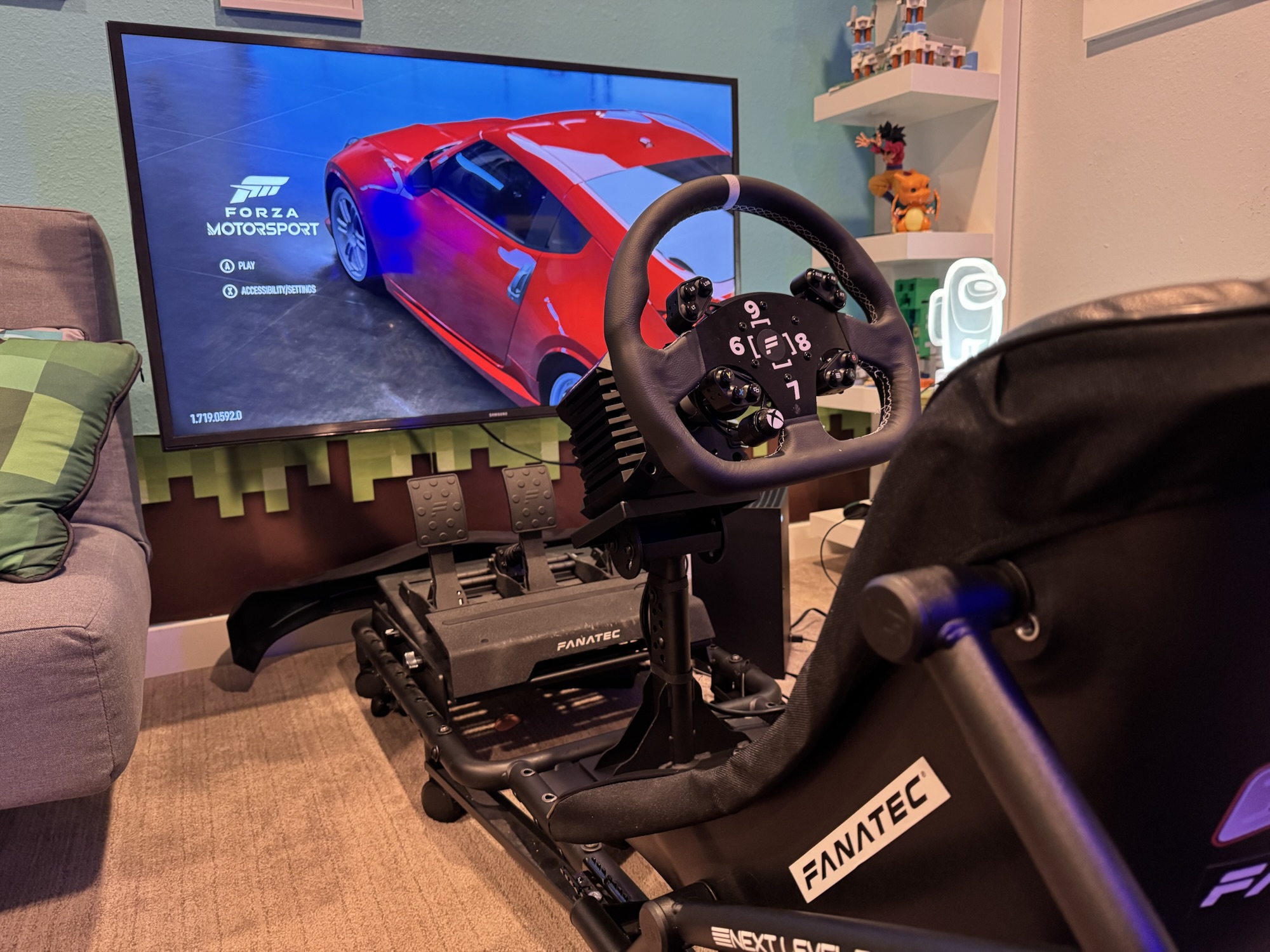
Below is the simulator setup we put in my son’s room:
We had an extra LG LCD TV around the house (wall mounted) – $0
Xbox Series X – $500
Fanatec CSL DD QR2 bundle w/Xbox and PC compatible wheel – $500
Fanatec CSL pedals – $300
Next Level Racing Go Kart Plus Cockpit – $500
Forza Motorsport – included in Game Pass subscription but base price is $60
Everything was plug and play. No drivers or software to install. Everything just works and you still have the ability to adjust wheel feedback settings within each game.
Note that unless you are for sure going to drive a manual car in real life, stick to getting a 2-pedal set. Since this is my son’s simulator (though I drive it a ton!) we haven’t gotten close to having him drive an H-Pattern shifter. The extra cost of the 3-pedal set was unnecessary.
How to Practice Effectively on a Simulator
To help our drivers develop real-world skills through simulators, we recommend following a structured approach with clear benchmarks:
Master Consistency: Start by choosing any car and track combination. If there is one that you can drive in real life, pick that one but it honestly doesn’t matter much. Maybe don’t start with the Nordschleife at the Nürburgring due to the massive length of a lap. The goal is to complete at least 10 consecutive laps within 0.5 seconds of your fastest time, without spinning or crashing. This builds smoothness and precision.
Progress to Career Mode Races: Once consistent lap times are achieved, begin participating in career mode races against AI drivers. This introduces racecraft, such as overtaking, defending, and maintaining focus in a competitive environment.
Increase AI Difficulty Gradually: After completing 10+ races without incidents of your own making, start increasing the difficulty of the AI opponents. This challenges you to compete against faster and more skilled virtual drivers, simulating a more realistic race environment.
Transition to Multiplayer Racing: When you’re consistently driving within 0.5 seconds of your best lap time and have completed multiple incident-free races against high-difficulty AI, it’s time to take on human competition. Join private or public multiplayer lobbies to test your skills against real-world opponents. There are some seriously fast simulator drivers all over the world so go in eyes wide open! Remember, your goal is to work on your skills for the real world, not to be a simulator racing champion.
Simulators are more than just games—they’re training tools. To get the most out of your time:
Start Slow: Begin with easier tracks and lower powered/lighter cars to focus on fundamentals like braking and cornering.
Learn the Racing Line: Follow track guides and in-game tutorials to understand the ideal line.
Focus on Consistency: Aim for smooth, repeatable laps before pushing for speed.
Experiment with Settings: Adjust car setups and difficulty levels as you improve.
Use Ghosts and Replays: Analyze your laps and compare them to faster drivers to identify areas for improvement.
From Virtual to Reality: Bridging the Gap
While simulators provide invaluable practice, transitioning to real-world driving requires adapting to physical forces and sensory feedback – it’s real! But the habits you develop on a simulator—like the foundational driver inputs, spatial awareness, and car control —make this transition significantly easier.
Many professional drivers, including F1 and endurance racing, credit simulators as a vital part of their training regimen. Even for am’s, the benefits are clear: more confidence, better instincts, and a deeper understanding of vehicle dynamics for when you hit the track in real life.
Your Next Steps
Whether you’re using a simulator to prepare for your first track day or simply want to enjoy the thrill of driving from home, this is a fantastic way to develop your skills. In future posts, we’ll dive deeper into advanced simulator setups, track-specific tips, and how to take your virtual driving to the next level.
Ready to start? Grab your wheel, fire up Gran Turismo 7 or Forza Motorsport, and begin your journey toward becoming a confident and skilled driver—one lap at a time.
One of the questions we spend the most time on around the shop and track is talking with people who are interested in getting into track driving but they simply don’t know where or how to start. So we figured we’d share our knowledge and recommendations over a series of blog posts so that these are easily accessible to anyone, at any time.
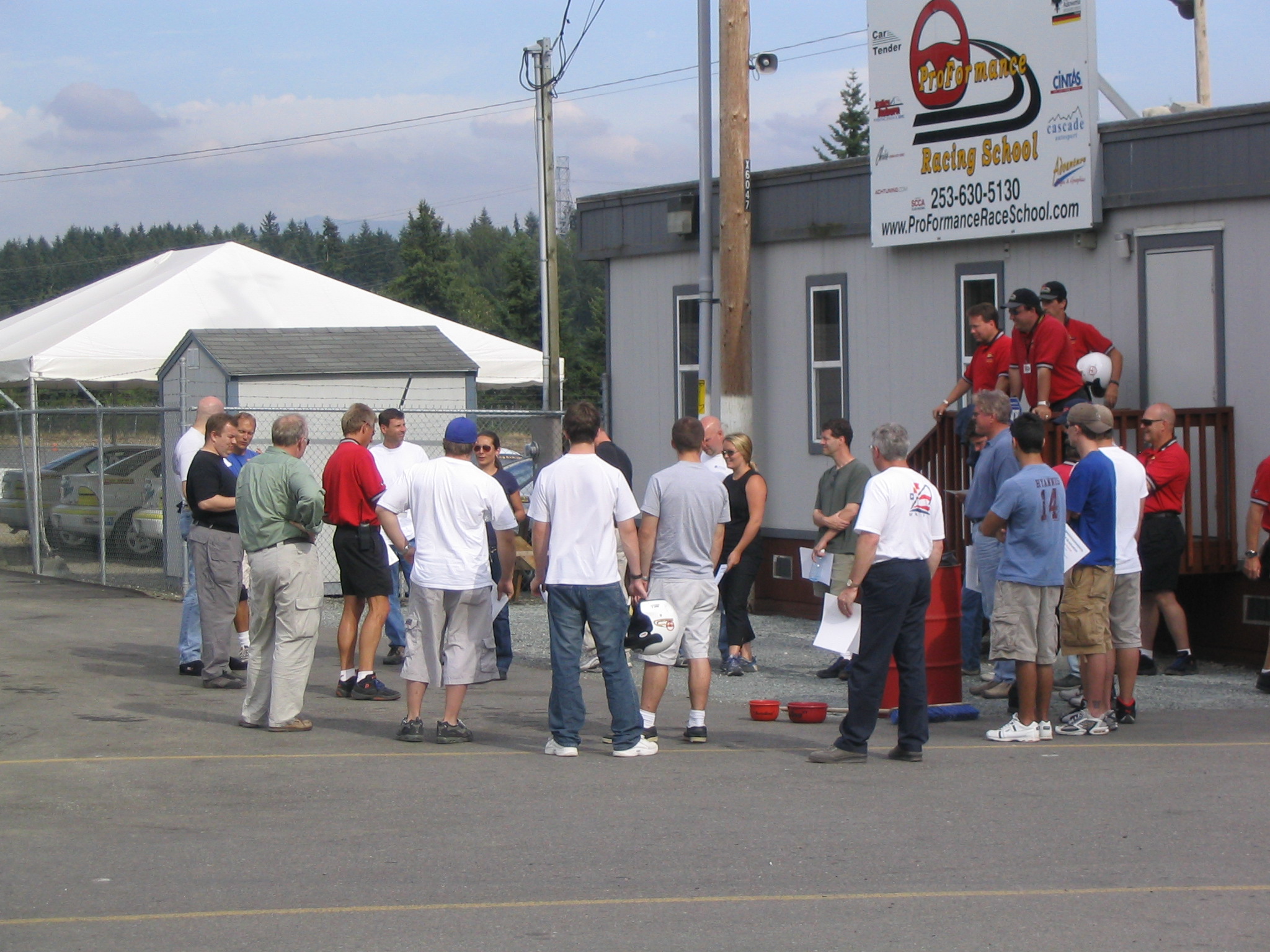
Track day drivers at ProFormance Racing School Track Day
For many aspiring drivers, the hardest part of breaking into high-performance driving is figuring out where to start. The idea of taking your car to a race track can feel daunting. What if you’re not ready? What if you don’t have the right car? What if you… spin out? The truth is, every seasoned racer once stood where you are now, full of questions and excitement. The good news? You’re not alone—and there are programs specifically designed to help you take that first step with confidence.
One of the best ways to begin your journey is by attending a High Performance Driving Education (HPDE) course. For example, ProFormance Racing School at Pacific Raceways in Kent, WA, offers a structured, supportive, and hands-on environment to help you master the fundamentals of car control and experience the thrill of driving on a race track for the first time. However, there are many similar high-performance driving schools across the country that provide a comparable experience tailored to beginners.
For those of you in the Pacific Northwest or willing to travel to the PNW, ProFormance isn’t just one of the best options on the west coast for an HPDE course because they are the home school for Pacific Raceways, but they legit have some of the best instruction and coaching available anywhere. Their team is made up of current and past active drivers who have climbed and hung on various steps of the racing ladder, all the way up to IMSA/SRO levels of driving.
What Makes a High Performance Driving School a Great First Step?
For most schools, car options are open, meaning you can either bring your own street car or rent a car from the school. Using your own car is entirely fine, as the focus isn’t on breaking lap records but instead on developing car control skills, awareness, and safety. Modern cars—even non-sports cars—have more performance potential than most drivers realize. As long as your street car has been well-maintained with healthy tires, brakes, and brake fluid, it’s likely ready for the track.
Additionally, formal schools like ProFormance Racing School emphasize the fundamentals of car control. These fundamentals are critical because a lack of solid basics can lead to bigger and more expensive mistakes when drivers exceed the limits of traction and don’t have the skills to recover. Learning these essentials early can save you from trouble later and set you up for success as you progress in your driving journey.
A high-performance driving school typically offers a one-day program thoughtfully split into two parts: a Skills Clinic in the morning and Lapping Sessions in the afternoon. Together, they provide a comprehensive introduction to high-performance driving that’s perfect for anyone—whether you’re looking to get into track days, time attack, or wheel-to-wheel racing.
Morning Skills Clinic: Building the Foundation
The day often begins with a classroom session where you’ll learn the essential principles of high-performance driving. This isn’t just a lecture; it’s an interactive session covering topics like:
Vehicle dynamics (understanding how your car responds to your inputs).
Skid control techniques (what to do if you lose grip).
Brake application (maximizing stopping power without losing control).
Vision skills (learning to look ahead and anticipate).
Once the classroom portion wraps up, you’ll take to the track for hands-on exercises. These drills are designed to sharpen your skills in real-world scenarios. You’ll practice emergency braking, skid recovery, cornering techniques, and more. The focus is on teaching you to think faster than you drive, making split-second decisions while staying composed behind the wheel. By the end of the clinic, you’ll have a solid understanding of how to handle your car in both routine and high-stress situations.
Afternoon Lapping: Putting It All Together
After a morning of skill-building, the afternoon is all about applying what you’ve learned. With an experienced instructor riding shotgun, you’ll transition to full laps on the track. The focus shifts to flow and precision, combining your new skills into a seamless driving experience.
The instructors work closely with each driver to:
Refine your technique in real-time.
Help you develop a better connection with your car.
Build your confidence at higher speeds and in more complex situations.
The afternoon lapping session is not about going as fast as possible. Instead, it’s about smoothness, consistency, and control—the building blocks of any successful track driver. By the end of the day, you’ll have not only improved your driving but also gained a deeper appreciation for your car’s capabilities.
Why High Performance Driving Schools Work
The beauty of these programs is their approachability. You don’t need a race car to participate; a street-legal car in good condition is perfectly fine. The instructors meet you where you are in your driving journey, tailoring their feedback to your skill level. This ensures that every driver, from absolute beginners to more seasoned enthusiasts, leaves with valuable insights and improvements.
Another major benefit? Safety. These schools prioritize creating a safe and controlled environment for all participants. You’ll learn how to push the limits of your car without endangering yourself or others, which is essential for anyone planning to progress to more advanced forms of motorsport.
The Next Step: Earning Your Sports Driving License
Once you’ve successfully completed a one-day high-performance driving course, you’ll typically leave with what’s referred to as a “Sports Driving License.” While not an official license, this credential is widely recognized by track day organizers as proof that you’ve received foundational training in high-performance driving. With this license, you’ll be eligible to participate in track day events, often under the oversight of an instructor.
This is where the real fun begins. After earning your sports driving license, it’s time to sign up for track days. We encourage new drivers to attend as many track days as their schedule and budget allow. Why? Because practice is everything. The more seat time you get, the more you’ll hone your car control skills and build muscle memory for critical driving techniques. Think of it as applying the “1,000 hours of practice” rule—consistent seat time leads to significant improvement and confidence behind the wheel.
Sports Driving License? Unlocks driving at many track day organizer events across the country… in your own car!
Alternative Options for Practice
Not everyone has access to a race car, a track car, or the resources to participate in frequent track days. But that doesn’t mean you can’t continue developing your driving skills. One excellent alternative is using a racing simulator on platforms like Xbox, PlayStation, or PC. Games such as Forza Motorsport, Gran Turismo, Assetto Corsa, ACC, and iRacing provide a surprisingly effective way to practice car control, learn new tracks, race against the clock in time attack events and even race wheel to wheel against AI-powered drivers and real people all over the world.
Sim racing is not just for fun; it’s a valuable tool for honing your driving instincts and mental focus. Many professional racers use simulators as part of their training routine and not just the incredibly expensive simulators. If you’re serious about improving but need a more accessible option, simulator racing is a fantastic next step. Stay tuned for an upcoming blog post that dives deeper into getting started with sim racing and how it can complement your on-track journey.
Can’t afford to do as many track days as you want? Get a simulator! Yes, even an Xbox or PlayStation 5 will work!
Step 2: Picking a Car to Drive at Track Days
Once you’re ready to take your driving journey to the next level, the question arises: What car should you drive in the future track days? This decision can range from using your daily driver to renting a fully prepared race car. Each option has its benefits and challenges, depending on your goals, budget, and level of experience. Stay tuned for a future blog post where we’ll explore these options in detail, helping you find the best fit for your track adventures.
Take the Leap
If you’ve ever dreamed of driving on a race track but didn’t know where to begin, a high performance driving school is the perfect place to start. Programs like those offered at ProFormance Racing School and similar institutions across the country will teach you the fundamentals of high-performance driving, build your confidence, and give you an unforgettable introduction to the world of motorsport.
Ready to get started? Look for a reputable high-performance driving school near you, book your first session, and take the first step toward becoming the driver you’ve always wanted to be. Trust us—once you’re out there, you’ll wonder why you waited so long.
Stop #3 in the 2024 Hoosier Super Tour took us back to legendary Road Atlanta, our 3rd year in a row and crossing our fingers for at least not a mega thunderstorm, snow, or freezing temps? It didn’t pan out like that at all but one could dream, right???
Coming into the weekend, we had Ann Doherty going for her second race in her new-to-her Porsche 911 GT3 Cup Car (991.2), Dave Orem in his BMW Z4M, Gama Aguilar in his Nissan 370Z and making his 2024 debut, Thad Berger in his Porsche Cayman GT4 Clubsport MR competing in Touring 1.
Road Atlanta: A Track Like No Other
Road Atlanta is a bucket-list track for racers worldwide. Nestled in the rolling hills of Braselton, Georgia, it’s known for its high-speed back straight away, technical corners, and dramatic elevation changes. The track demands respect and skill, as drivers navigate iconic sections like the Esses and the infamous Turn 12, a downhill blind corner that tests both bravery and car setup.
The track’s layout, with a mix of medium and high-speed corners, challenges a car’s balance and requires a careful blend of mechanical grip, aerodynamic efficiency (where applicable), and driver finesse. Long straights demand top-end power, while technical sectors, like Turns 3 through 5, test the setup and throttle control. Adding to the challenge, elevation changes require cars to manage weight transfer effectively, which puts additional emphasis on precise braking and cornering. This is a fun track, a scary track, and it requires drivers be on top of their game to get the most out of themselves and the car, with high consequences on the outside of most corners due to limited runoff.
The Wild Card: Mixed Weather Conditions
The weekend at Road Atlanta was a perfect example of how unpredictable weather can add another layer of complexity to motorsport. Cold mornings, sudden rain showers, drying lines, and gusty winds all made an appearance, pushing both cars and drivers to their limits.
From a car’s perspective, fluctuating weather conditions impact nearly every system:
Tires: Tire pressures and compounds become critical as track temperatures rise or plummet. Wet or intermediate tires need careful management to avoid overheating on a drying line, while slicks can struggle to find grip on damp patches.
Braking: Wet weather reduces braking efficiency and increases the likelihood of lock-ups, especially in high-speed zones like the run into Turn 10A and 10B.
Aerodynamics: Strong winds can affect a car’s stability, especially in high-speed sections like the back straight. This requires drivers to stay vigilant and adjust their steering inputs accordingly.
Traction and Balance: Mixed grip levels from a drying track demand precise throttle and steering inputs, as any abrupt movements can unsettle the car and lead to costly mistakes.
For drivers, preparation is key to handling these challenges. We as a team are glued to various weather services and adjust the approach based on the session’s conditions.
In wet conditions, smoothness is paramount—gentle braking, progressive throttle application, and careful steering are all necessary to maintain control. When the track begins to dry, drivers need to identify and exploit the developing racing line, where grip is highest, without overworking the tires (like we did last year, going on wet tires for what ended up being a mostly dry race).
Ann’s Focus: Learning and Feeling the Car
The goal for race 1 in her new car was simply to operate the car and start to acquaint herself with how the car drove; results were a non-variable. As we covered in the last race report for NOLA – mission accomplished! The biggest take-away Ann had from the first weekend was, this thing is a BEAST and without the driver aids of her former car (Porsche Cayman GT4 Clubsport) her inputs had to be that much more precise, especially on brake release and throttle application.
Ann Doherty cutting up through the Esses at Road Atlanta
At Road Atlanta, we moved to a second phase of learning the car. She knows how to operate the car and where all the switches and buttons are located, now it was time to start focusing on how the car truly feels. Specifically, how the car communicates weight transfer from side to side (how do we know when the car takes a set?), the balance of the car rear to front when hitting the brakes and most importantly, getting on that throttle.
Throttle application is critical for every corner but especially at Road Atlanta which is dominated by medium to high-speed corners (the slowest corners have a target min speed of 48-50 mph!) and multiple corners with a target min-speed of >70mph, how she applies throttle, even with some of those exits going into a hill-side, would be critical.
By focusing on her inputs throughout the test day, Ann got herself into a competitive window in the first qualifying session on Friday mid-day with a 1:28.743 and P6 out of 14 in GT2 – great start and knowing there was more potential waiting to be unlocked.
Saturday AM was supposed to be a second qualifying session but with a MAJOR storm rolling through Friday overnight, the track was fully wet and zero chance of anyone going faster than the day prior. Ann and most competitors took the session off to focus on the race which would end up taking place on a mostly dry and green track. Ann had a great start to the race, losing one out-of-class position on lap 1 and holding her own through the first FCY of the race. With the cars packed back up for the restart, she lost positions trying to avoid contact and started picking her way through the field and battling an out-of-class Porsche GT3 Cup Car (running in GT1).
Multiple FCY’s ended up stopping competitors from getting into a flow and after another re-start, she got on throttle just a bit too aggressively and ended up having the rear end of the car come around on her. It also didn’t help that there was clay mud all over the exit curbs from the weather throughout the weekend.
Ann gathered herself up, got back on the track and finished in 9th place. Lots more learned and Ann is ready to keep figuring out her Cup Car at VIR!
Dave’s Focus: Better Feel for the BMW Z4M
This would be Dave’s second race weekend in his Touring 3 2023 SCCA National Championship winning car. Dave started cutting his teeth on the Z4M at Sebring but mixed weather conditions and adjusting to car that is not as heavily prepared as a Spec E46 on the drivetrain front, meant that Dave would need to focus hard on those heel-toe downshifts to maintain the car balance as he entered corners.
Dave Orem climbing the hill at the Road Atlanta Esses
Dave put his head down and started chipping away at the lap time qualifying P12 but unfortunately the ear on the rear diff cover had enough. The ear failed which started causing harsh clunking/vibrations and while we were able to locate another diff cover, it wouldn’t arrive on time for Dave to make the race.
Big Bummer for Dave but on the bright side and as preview for a future post, this was the straw that broke the camels back. Dave left the paddock determined to learn to heel-toe downshift and leave these issues behind.
Stay tuned for the lengths and efforts Dave went to become a heel-toe master downshifter!
Thad’s Unfortunate Debut
Due to scheduling conflicts, this was Thad’s first race of the season and after an off-season of sim training and building off an incredible driving experience at the previous year’s June Sprints, Thad was ready to hit the asphalt hard!
On the test day, Thad went out for the first session to just shake the dust off himself and the car. Thad came back with smiles and starting to feel it as his best lap time of the session was already near the front of the mid-pack T1 pace that we expected for the weekend! Let’s go!
Second practice session and towards the end of the session, another car loses control coming down the back straight away collecting Thad and causing significant damage to the passenger side of the car.
Thankfully, all safety systems worked properly and Thad walked away from the incident without injury. The Porsche Cayman GT4 MR will need significant repairs and will likely be the last we see the car for at least the 2024 season.
Gama’s Focus: Touring 3 Maximum Results
Quite the race weekend already, right??? For Gama, the focus was on continuing to develop the car by ensuring that we didn’t see anymore the electrical issues and fine tuning the braking system.
The car felt okay through the test sessions leading up to the qualifying sessions but the brake release continued to not feel great, especially when we got into mixed conditions. This meant that I couldn’t attack really any braking zones so the goal was to get up front and stay up front so that I didn’t have to get into too many out-braking duels.
Welp, that plan didn’t pan out too well. haha! Ended up P2 in the Qualy 1 session and P1 in Qualy 2 session, but combined and overall across both qualifying sessions, I’d start race 1 in P3 overall, behind Simon Foweather (Spec E46 in T3) and a Ford Mustang in T2 (out of class car).
Below is a link to a compilation of what would end up being nearly all our green flag running across both races. Each race had multiple FCY incidents where the net result was a P2 in Race 1 and P3 in Race 2. Race 1 started in wet conditions and eventually got to mixed, so it was a game of traction and requiring full wet tires.
Race 2 was full dry but due to the FCY, we simply didn’t have enough green flag laps for anyone to get into a groove and show any sustainable pace.
Was a bummer to not be standing on the top step when we believed the car had the potential and just needed more green flag laps. But all things considered, it’s still a double podium weekend in very tricky conditions, at a fun but dangerous track, and the car is one piece. #grateful
The second stop in the 2024 SCCA Hoosier Super Tour schedule for the team was NOLA Motorsports Park – a new track for all the drivers and most of the team. Relatively flat, built on a swamp and host of SRO GT Americas race events the past few years, NOLA ended up being a decently technical track and the Louisiana weather initially welcomed us with 70F, sunny and with a breeze weather. But once the test day came, the cold air from up north and a weather system from down south decided to join the party and aside from Sunday, we had low 40F temps, rain, and wind. Why do we even leave the PNW to go racing???
Thoughts on NOLA
Flat, minor (but critical) banking in some corners, no point-n-shoot corners and not a lot of time above 120mph meant that balancing the car in the cornering bits was going to be a premium.
NOLA has 16 corners with 10-11 of them (depending on how you count the corners) are right hand corners and there are two sections of the track where you have consecutive right hand-corners, which makes those left-side tires important. From Turn 4, you are only making right hand turns until Turn 10! Turn 4 is a slower speed corner which requires a good amount of mechanical grip. Turns 5, 6 and 7 are higher speed corners where you are trying really hard to not over-slow for turns 5 and 6 but as you try to carry the speed into those corners, the left rear tire is taking a beating from the slight high-speed yaw action when trying to rotate the car and then accelerating through the corner.
The esses complex is relatively straight forward but carrying speed into Turn 9 (the first ess) is critical and sets up the rhythm through the rest of the complex.
Finally, the left side tires only get a mini-break before needing to turn hard at Turn 13 and then suffer through a long duration compound section of Turns 13-14, which leads onto the main straightaway.
If you’d like a more detailed walkthrough of the track, check out this video that came in super handy from ASM and Tom O’Gorman.
Credit: ASM + TOMO Coaching
Ann’s new baby shark! 991.2 Porsche GT3 Cup Car
As some of you may have read in past posts, Ann has been developing at a rapid pace the past couple of years and driven the wheels off a Porsche Cayman GT4 Clubsport, mostly in SCCA GT2 and T1 classes. At the end of the 2023 season, with the repairs needed on the car from a failed tire during the runoffs, Ann made the decision to move on from the Cayman and jump into a GT3 Cup Car. So she spent the off-season looking for options and just in time for the NOLA race, we took delivery of her new steed on the Wednesday before the race weekend. Exciting but yikes!
With her car being new to the team and her and limited information of the running state, we set low expectations for the weekend: get the car on track, have it circulate consistently and have Ann start to build confidence in the car. Any specific result was not a consideration at all for the weekend.
Look at the butt on that! Yeah – it must work out. Ann’s new 991.2 Porsche GT3 Cup Car!
Jordan got to work on the car and after completing a full inspection, we were in decent shape! There were a couple of suspension bits to monitor, some to proactively replace but aside from that, it was just work to get the car personalized to Ann’s preferences and get the car out on the track so we could know more confidently, what we had on our hands. The car was ready to test on Friday but straight up gross, wet, and cold conditions, we made the team decision we’d wait until Saturday where there was a window of potential dry weather.
Saturday started off wet but the rain started slowing around 9-10am, just in time for qualifying. Ann went out on wet tires in case it started raining again (it didn’t) for her maiden voyage and by the end of the session, we had a clean bill of health! By the afternoon race, we fitted a set of the used tires the car came with and sent her out to get more laps, see what breaks and build confidence! After race 1, she moved up several positions, finished P6, nothing broke and ended the race with the last 2-3 laps at a decent enough pace where we could actually start looking at performance.
On Sunday, we finally got a break in the weather with the system that ended up delaying the Daytona 500, moving south of us, leaving us with clear skies but COLD winds. Beggars can’t be choosers! Ann continued to take time off her lap times during qualifying and exchanged places to finish P6 out of 13 in her first race! In race 2, Ann picked right back up where she left off, took another 2 seconds off her fastest lap time to finish with 4 laps in the low 1:50’s. All again on 2 year old used tires with unknown number of heat cycles. Safe to say that Ann is loving her new Porsche GT3 Cup Car and is ready to build on this for the next race at Road Atlanta!
One last thing on Ann to put things in perspective. Just a few years ago, she had never been on a race track, let alone raced wheel to wheel. ~3 years in and developing at a very high rate in a Cayman GT4 Clubsport which is mega fast but has a lot of driver aides, she decided to move onto a monster of a platform. She not only jumped in with full confidence to drive, but she truly slayed this beast on her first outings in it. Incredible job, Ann!!!
Ann driving back into the pits from her first on-track session in her new Porsche 911 GT3 Cup Car!
Dave continues building on his BMW Z4 M Coupe
Dave took his new-to-him BMW Z4 M-Coupe out at Sebring for the first race weekend and made solid progress on the new platform but NOLA brought a whole new set of challenges with the weather and the gearing. The Z4M has won the SCCA Runoffs the last 2 years in a row, in large part due to the M3 based gearing. Nice and tall gears to let it stretch it’s legs out on the long straight aways. NOLA doesn’t have any long straight aways, so we knew going into the weekend that the gearing wouldn’t be optimal for the car but we’d still make the most of it.
Dave took part in all of the test day sessions but as covered previously, the conditions were horrible so they were good for getting a sense of the track from simulator preparations but gave next to no representative data for what ended up being dry the rest of the weekend.
Dave (and Gama) qualified on Saturday AM on wet tires (along with the rest of the field) but it ended up being damp to drying track surface. In race 1 Dave got out to a good start, avoided spinning on the oil left by a T4 car that dropped oil around the final corners leading to the main straight away and finished P6, one spot behind Gama who spun on that oil and had to battle his way back from last place.
On Sunday, Dave worked committing to throttle in one smooth motion during qualifying and dropped another almost 2 seconds from his personal best! In the race, which finally brought some track temperature with the sun appearing, he built on those learnings, took advantage of mistakes from other drivers and came in P5, chipping away at the gap to P4! Road Atlanta should be better suited for the powerhouse BMW Z4M with that long back straight away, two uphill sections where torque pays off big time and it being Dave’s 3rd time back to the track!
NISMO 370Z Starts to Deliver on it’s Potential
At Sebring, we saw signs that the 370z could compete for podium positions but rain in the wiring and dealing with the ice mode issue held us back from being able to truly show the car’s potential. Fast forward to NOLA where the brake vacuum controller that was requested to be allowed, was approved (yay!!) but not legal until March 1st, we had to figure out how to make due with an ABS System that could freak out at any point. We tried a few different things and while not perfect, they were good enough for us to feel comfortable running the car for the weekend.
On the morning of the test day, we decided to switch to wet tires due to the rain that had started but a wheel stud failed when trying to remove the wheel. Ugh! Memo jumped on the problem and 3-4 hours later, the car was ready to go, only to make the last test session of the day, just to make sure everything stayed together. Hats off to Memo’s effort and problem solving – as we chatted on the sidelines through the repair, had this type of an issue occurred while any of us drivers would have been there on our own – game over. Someone help me push this thing into the trailer but with Memo and or team on-hand, dang near anything can come up and as long as it’s safe, they’ll get the car back on the grid.
In the Saturday AM qualifying, we went out on wet tires like everyone else and finished P4, believing we had more pace in the car and on the second row, so all the things to play for. In the Saturday afternoon race, towards the end of lap 2, someone lost an engine, dropped oil all around the last couple corners. In the heat of the battle and with wet spots all around, I didn’t spot the oil (though the team had radio’ed it in) and got caught out when the rear tires hit the oil.
It took me a bit to get the car re-fired and out of the completely soaked grass but got going again, put my head down, worked my way back to P5 and was catching the leading group at 1-2 seconds per lap (of which I didn’t realize at the time and was somewhat frustrated with my pace).
The next day for the Sunday AM qualifying, we swapped on some lower heat cycle tires (specifically, the tires that I used during the VIR Runoffs in the installation laps/sessions) and a new tire on the front left corner. Better tires but still not a full on sticker run. First flying lap was good but I wasn’t pushing 100% and tires weren’t fully into the working window. The 3rd flying lap I let it all out and found myself a very fast Danny Stein in his Mazda STL car which provided a nice tow around the track, which resulted in a 1:55.2XX and pole for T3! On the next lap, I was slightly up on that 1:55.2XX lap time and I was going for another flyer to try and improve. I braked at the same point for Turn 1, did my downshift, turned in and then full front end lock up – sigh. This would end up being a telling sign of the rest of the day.
For the race, we decided to raise the car all around to help with compliance around the bumpy track. Thanks to fellow Nissan racers Rick Kulach and Richard Baldwin, we were able to get our hands on some taller front springs and made the change in time for the race.
Watch the Sunday Touring 3 Race where Gama Aguilar starts in P1 and leads from flag to flag.
When the race started, I focused on getting a good start and ideally not be competing for the corner going into Turn 1. Luckily that happened and after the first lap, decided to pump out the fastest laps I can could muster so that I could build a healthy gap to P2. All was going to plan until I locked up going into T13 and had to take the escape road. Lesson learned that even though I thought the tires were still fresh, it was simply too much speed for this *awesome* (sarcasm) brake system to handle. From then on, I focused on braking a little earlier and softer in all braking zones, knowing I’d be leaving some time on the table but that would be better than locking up and flying off the track.
My plan was to steadily build the gap so that by the time we hit lapped traffic, I could use that pull away. Unfortunately, the rest of the competitors were not aware of my plan. haha
Sometime about mid-way through the race, someone lost a big lip spoiler or some strip of something that was 4-5′ long and right at the exit of Turn 8 of which I didn’t see until it was too late to do anything but run right over it. There was some loud banging as it went under the car and I had to slow to figure out if anything had impacted the handling/safety of the car. No issues but I lost a solid 1-2 seconds.
The next couple of laps, I had to take Turn 8 more cautiously so that I could see where that object was and not run over it again. Perfect. 🙁
Some laps later, Richard’s 350Z had a tire failure and he pulled off to the right of the essess, causing a local yellow. I ran up on a lapped T3 Mustang right in that spot and there went my entire gap to P2. From then on, it was a battle to steadily build up that gap.
Clearly bias but look at this thing!
Another thing that I have been struggling with is the shifter and specifically, the 5th to 4th shift where the shifter doesn’t self-center and will easily drop into 6th gear, not 4th gear. That shift is critical for Turn 8 and I had to over slow to make sure I got the shift done right and even then, I screwed it up a couple of times – another .5-.75 seconds lost on each screw up.
With a few laps left in the race, started coming up fast on a T4 car going into the essess and made the judgement call to make the pass before we got perpendicular to the standing yellow flag – barely made it!
Finally, going into the last lap, I was focused on matching or improving my personal best, knowing the left side tires were struggling. Half way through the lap, I was almost matching my fastest lap but knew I was vulnerable in the essess due to the 5th to 4th shift but still had a decent run through the section. P2 car was on my rear bumper so going into Turn 13, I ran a more defensive line, braked earlier and softer, go the downshift done and when I started turning, the front end locked up again.
My only choices were to continue plowing forward and straight into the grass, of which when that happens, I would have likely lost control of the car until it hit the asphalt again OR come of the brake and straighten the wheel so I could take the escape road. I did the second path as I had earlier in the race, then focused on making sure I didn’t make contact with anyone while rejoining the course. Coasted through the escape road, looked to my right, saw no cars and then rejoined with a primary concern of not causing a wreck.
Ended the race in P1 but post-race, the stewards felt like I gained an unfair advantage by taking the escape road and while that wasn’t my intent at all, I had no argument against it. Minor disappointment but in the grand scheme of things, very pleased with the results.
We made it through a weekend without the brake vacuum regulator and no damage to the car or other cars, learned more about the car and finally got consecutive on-track sessions to build base level confidence in the car. This car is finally showing the potential we know it has!
Mega thanks to the whole Racer on Rails team that made the NOLA SCCA Hoosier Super Tour weekend a massive success! Next up is Road Atlanta in March where the team is looking to build on success and momentum in 2023. Let’s go!!!
We’re thrilled to publicly welcome Jesse Hasson to our team as the new Shop Porter and Apprentice Race Technician. Jesse started back in September and has been getting up to speed and helping the Racer on Rails wheels continue to churn. Jesse’s journey into the world of racing and car mechanics is not just a career choice but a lifelong passion that has been nurtured from a young age.
Jesse’s love for cars and racing sparked early, growing up with a wrench in hand alongside his father. “From the day that I replaced the water pump in our family truck alongside my dad, I knew that working on cars was my lifelong passion and hobby,” Jesse shares. This early experience laid the foundation for his deep-rooted love for all things automotive.
Further honing his skills, Jesse attended Renton Technical College, where he immersed himself in the world of car mechanics. His time at Renton wasn’t just about learning; it was about embracing the complexity and beauty of what makes cars tick. Jesse’s education went beyond textbooks, delving into the practical, hands-on experience that is crucial in our field along with helping on side projects around the shop and working during the race weekends for a while before he officially joined.
But Jesse’s ambitions don’t stop at just fixing and maintaining cars. He dreams of being behind the wheel, competing on the race track. “It is also my lifelong dream to one day competitively drive race cars,” he says with determination. This dream adds an extra layer of enthusiasm and understanding to his role with us.
As our new Shop Porter and Apprentice Race Technician, Jesse brings not just technical skills, but a genuine passion and understanding of the racing world. His role is pivotal in helping the shop operate properly and to help us maintain the high standards of race cars that we manage, ensuring they are in top condition for every race and event.
We believe that Jesse’s passion for racing, combined with his budding technical knowledge, makes him an invaluable addition to our team. His journey is a testament to following one’s passions and turning them into a career. We can’t wait to see the contributions Jesse will make to our team.
Welcome to the team, Jesse! The race track just got a little more exciting with you on board.